My fav. piece on Detroit’s bankruptcy

Since July 18th, many media outlets are targeting towards Motown’s bankruptcy. I’ve read a lot of news pieces on this issue. Some look to the optimistic side of the bankruptcy and some start to worry about their own pensions, though they don’t  live in Detroit. Among these pieces, I chose one piece which I consider to be the most juicy and resourceful piece.

Can Motown be mended? From: The Economist
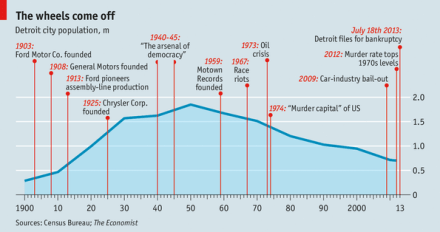
The Wheels come off

Click on the above pic or HERE to go to the article.

I love infographics. I love how they show us the facts so easily and obviously. Detroit was rising because of the motor industry. It failed due to the same reason. It needs diversity, desperately. Let’s see how The Economist sees the problem. They provide quite a lot statistics:

Detroit is the largest American city ever to file for bankruptcy. Its long-term debts are estimated at $18.2 billion, or $27,000 for each resident. Of this, about $9.2 billion is in unfunded retirement benefits. Since 2008 the city has spent around $100m more each year than it has brought in. Recent attempts to fix its finances have been thwarted by a feeble economy, a shrinking population and rapidly increasing legacy costs. Property-tax revenues have declined by 20% since 2008, and income tax by 30% since 2002.

As of the question how soon and how well will Detroit recover from this bankruptcy, no one can answer with confidence. There are only a few options for Detroit:

Detroit’s future depends on the deal Mr. Orr can cut. He argues that, if the city is to recover, it must invest $1.25 billion in restoring services such as the police and firefighters, remedying urban blight and modernizing the city’s decrepit IT systems. Neither the state nor the federal government has offered a bailout. Mr. Orr says Detroit must solve its own problems.

No one is there to help. They are on there own. Big city falls down. That may soon be a common phenomenon all over the world. Let’s not worry about the world first. It’s more realistic to focus on the question of whether we’re going to get our pensions.
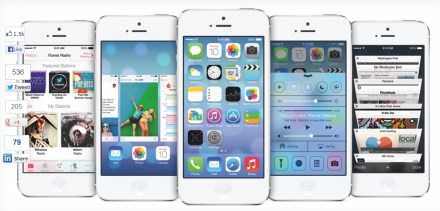
From The Verge: Tracing iOS 7’s influences: Apple remixes almost everyone in the industry

iOS 7


The above pic shows main features of iOS 7. (Image from The Verge)

iOS 7 is freshly released. When a product is out there, it’s for people to judge. So… what do people think of it? Here is some extremely angry designers talking about iOS 7. –> Complains

I don’t mind the flat design, but the color scheme is just unacceptable. Aaron Souppouris described iOS 7 as “a marriage of designs with something old, something new, something borrowed, something blue.”

From The Verge:

Such is the nature of software design; we could go through Apple’s entire UI and pick apart the influences. Apple’s new incoming call screen, which calls on users to “swipe to answer,” is similar in function to Samsung’s TouchWiz, and looks just like Windows Phone 8. The playful “parallax” backgrounds, which shift when you move your phone, were demoed by now-BlackBerry-owned TAT in 2009. The Camera app now lets you take square pictures and apply filters — sound familiar? Speaking of the Camera app, that icon looks an awful lot like BlackBerry 10’s. Aren’t those “motion backgrounds,” which feature circles and lots of soft bokeh, just like the wallpapers introduced by Google in Android Ice Cream Sandwich? The list goes on. But let’s travel back to 1994, when Steve Jobs famously paraphrased Picasso, saying that “good artists copy, great artists steal.” Taking concepts and interpreting them as your own is something all creatives do. It’s this interpretation and improvement of ideas that’s key. With iOS 7, the question isn’t whether Apple’s artists are copying or stealing good ideas — it’s whether they’re doing a good job evolving them.

It’s true. 问题不在于是否抄袭或者偷得好创意,而在于有没有很好地发展他们。

From VB: The mobile war is over and the app has won 80% of mobile time spent in apps

Apps rule the world and Facebook takes as much as 18%. 80% of our time on smartphones are spent on  apps and 18% of that amount was spent on Facebook. Maybe it’s time to turn of the phone and take a break.

Flurry 关于美国人在智能手机上所花时间占比的图表,VB 进行了讨论。80% 的时间被 app 所占,所以得出结论:这是一个属于 app 的世界。2012 年的数据显示每天上线的新 app 平均就有 7.9 个,越来越多的 app 想要占据这个市场。平均每人在 FB 上每天要花费半个钟头,这个数据很可怕。我们花在这些应用上的时间越多,精力就越为分散。而我个人也发现花在「碎片阅读」上的时间日渐累积,「完整阅读」的机会就越来越没有,而离开「完整阅读」,根本就失去了知识的输入。这里的「完整阅读」,指的是读书和做研究考据的阅读,以后再详谈。

See this graph:

From VentureBeat:

According to app analytics firm Flurry, which tracks app usage on a staggering 300,000 apps on over a billion active mobile devices, we spend an average of 158 minutes each and every day on our smartphones and tablets. Two hours and seven minutes of that is in an app, and only 31 minutes is in a browser, surfing the old-school web.

A big chunk of that 158 minutes is taken up with games — 32 percent — but it’s almost shocking to see how much time a single app and a single company eats up. Eighteen percent of all the time that Americans spend on their phones is spent in the Facebook app, a figure that by itself dwarfs all other social networking apps.

From VB: CoutureSQD launches its ‘Netflix for clothing’ service (exclusive)


It’s interesting that someone considers a rental business in low-cost clothes. People can spend money renting an expensive wedding or dinner dress, but will they rent a box of clothes they could easily afford?

关于成盒租售平价衣物的一个想法,很有意思。

For $25 a month, Wu will send you a monthly “box” filled with clothing from stores like Zara and H&M. Boxes can be ordered on the website CoutureSQD by theme, such as professional or date night. Each box contains three outfits, which you can keep for as long as you want.