Since July 18th, many media outlets are targeting towards Motown’s bankruptcy. I’ve read a lot of news pieces on this issue. Some look to the optimistic side of the bankruptcy and some start to worry about their own pensions, though they don’t live in Detroit. Among these pieces, I chose one piece which I consider to be the most juicy and resourceful piece.
Can Motown be mended? From: The Economist
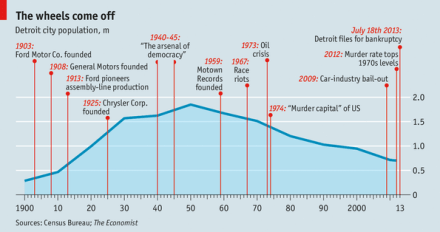
Click on the above pic or HERE to go to the article.
I love infographics. I love how they show us the facts so easily and obviously. Detroit was rising because of the motor industry. It failed due to the same reason. It needs diversity, desperately. Let’s see how The Economist sees the problem. They provide quite a lot statistics:
Detroit is the largest American city ever to file for bankruptcy. Its long-term debts are estimated at $18.2 billion, or $27,000 for each resident. Of this, about $9.2 billion is in unfunded retirement benefits. Since 2008 the city has spent around $100m more each year than it has brought in. Recent attempts to fix its finances have been thwarted by a feeble economy, a shrinking population and rapidly increasing legacy costs. Property-tax revenues have declined by 20% since 2008, and income tax by 30% since 2002.
As of the question how soon and how well will Detroit recover from this bankruptcy, no one can answer with confidence. There are only a few options for Detroit:
Detroit’s future depends on the deal Mr. Orr can cut. He argues that, if the city is to recover, it must invest $1.25 billion in restoring services such as the police and firefighters, remedying urban blight and modernizing the city’s decrepit IT systems. Neither the state nor the federal government has offered a bailout. Mr. Orr says Detroit must solve its own problems.
No one is there to help. They are on there own. Big city falls down. That may soon be a common phenomenon all over the world. Let’s not worry about the world first. It’s more realistic to focus on the question of whether we’re going to get our pensions.
 Momolog